Follow me on Twitter

Sunday, December 2, 2012

Think Like A Chef - Braising


In his book, Think Like A Chef, Tom Colicchio describes the taste of braised food as “…achingly rich, mellow flavors and meats so tender they melt in your mouth.”  He notes that braising is the integration of flavors, rather than emphasizing individual components.  Sounds good to me!

As he notes, braising is basically a combination of two main techniques.  First there is dry cooking in order to brown the food, then moist cooking where the food is transferred to a pot, and then cooked gently.

Colicchio also points out that braising expands your cooking repertoire quite a bit.  I think I see why.  You don’t simply braise in water, though I suppose you could.  You need a good flavor component to braise your food in, such as full flavored stock.

The thing that really attracted me to this book was this quote: “I like to teach braising, because I love the idea of a home cook walking the supermarket aisles and seeing each new item as an opportunity.  Instead of thinking, Pork shoulder?  What could I possibly do with that?  You’ll be thinking, “Aha, pork shoulder.  I’ll braise it, and maybe add a few parsnips and turnips…” Exactly the type of thing I am trying to learn to do!

The other thing Colicchio likes about braising is how it creates it’s own sauce.  He notes that the braising liquid, once it is reduced makes a simple, yet intense sauce.  He also points out that braised food is not neat food.

So here is the basic braising technique:

Brown the food. Add enough liquid to surround but not cover the food and transfer the food to an oven, uncovered at somewhere between 250 and 350 degrees. For fish, serve right away, for meats, you can serve right away, but it is better to let it sit in the fridge for a day or two in order to really develop the flavors.  (Kind of like the Bolognese dish from Anne Burrell that I make.  Really good after I make it, but 100 times better the second day…and third day…. and…you get the idea.)  Finally, reheat the braised meat.

Now, having gained a pound in the last couple of weeks, I decided to start with a more calorie friendly dish.  It seems that a lot of the braised dishes use high calorie/high fat proteins.  Because I can’t find red snapper anywhere, I am starting my braising education with haddock that braises in a rosemary-lemon vinaigrette, corn which I will finish in the braising liquid,   and roasted brussel sprouts that I will finish with lemon zest to marry all of the flavors.

We’ll see how I make out!

Tuesday, November 20, 2012

A Thanksgiving Letter


Why do we hate?

There seems to be a lot of hate in the world these days.  Just look at the Middle East.  Hatred has been going on there forever.

Unfortunately, we Americans are not immune to hatred.  This bothers me, especially when we are approaching Thanksgiving.  Look at our political discourse.  The racist venom that has been spewed upon President Obama since he was re-elected has been horrific.  And to my liberal friends, don’t get all high and mighty.  I remember plenty of pictures of President Bush with Nazi symbols spray painted on the picture.

On a smaller scale, why do we seem to feel that we have to bully others?  I suppose, to a certain extent, our brains are wired that way.  Back in the caveman days, the stronger species had to survive, so they killed the weaker.  But have we not learned from our mistakes?  After Columbine, why do so many people still seem to take a casual attitude towards bullying?  Why must we continue to have teen suicide because people think it’s okay to pick on someone who, in most cases, cannot defend themselves?  Why must we pick on someone because they’re gay? 

Is it religion?  My father used to say that, if it weren’t for religion, we would not have had so many wars.  And John Lennon told us to “imagine no religion.”  (Hey, I’m using my dad and John Lennon in the same paragraph…) 

We always hear stories on the news about people coming over from other countries, using our school system to better themselves, yet still hating America.  And we always hear about how so many people hate Muslims, even those who were born in this country and love America.

And what happened to that phrase, “I may not agree with what you said, but I will defend your right to say it.”  Has that gone by the wayside?  I fear it has.

As we approach Thanksgiving, I know that, at some point, I will be asked what I am thankful for.  Of course, I am thankful for my friends and family, especially thankful for an incredibly understanding wife (hey, she does have to live with me, you don’t…), and yet, I feel a bit melancholy.

Because I feel we can do better.  We can do better as a people, and as a nation.  We can dislike whoever is President, and still respect him.  We can talk to our kids about bullying.  And we can try to understand another’s way of life, be they white or black, Catholic, Jewish, or Muslim, gay or straight. 

You know, folks, if you think about it, we are on this earth for a very short time.  We really have very few opportunities for happiness.  Isn’t that what we should be focusing on, rather than hate?
Just because you disagree with someone doesn’t mean you have to hate them. 

Right?

Happy Thanksgiving,

Mike

Monday, November 5, 2012

Think Like A Chef - Roast Lobster


The next roasting recipe in Think Like A Chef is Roast Lobster with Bay Leaf.

The first thing that came into my mind when looking at this recipe was, what shall I serve it with?  If you are from New England, I think the first thing that comes into your mind is corn on the cob and new potatoes.  That would have been a bit easy though, and I wondered if I could somehow combine those two flavors.  I wanted some kind of…hash!  Now, I did not know how to put together this hash, so I cheated and found one on line.  It is a Robert Irvine recipe.  Admittedly, this was kind of a fatty dish, and as I looked at it later, I think I could have cut down the fat in the dish, but more on that later.

The recipe called for a whole large red onion, 2 cloves of garlic chopped, ½ pound of corn, goat cheese, dill, a diced tomato, and a pound of potatoes diced.  I used new potatoes.


Knife skills are getting better!
 

First, I had to sauté the onion, garlic and corn.  Now, I found a mistake in the recipe, as it called for ¼ cup of oil heated over low heat then sautéing the food.  Well, sauté means high heat with little fat, so I only used 1½ tablespoons of oil.  He calls for grapeseed oil, but I just used canola oil.  In the meantime, after having diced up the potatoes, I salted and peppered them, then coated them in ¼ cup of oil.  I think this was where my mistake was.  I should have started with 1½ tablespoons.  I went with the full ¼ cup as he says the potatoes must be completely covered.  I should have remembered, “You can always add more but you can’t take away.”

Next, I put the potatoes in a roasting pan and covered them with the onion, corn and garlic mixture, and put it in a preheated 375 degree oven.  Simple enough.  


Now onto the lobster.

Try as I might, I could not kill the lobsters by just pulling them apart, or putting a knife through the head, so I boiled them first, for just a minute.  After a minute I pulled them out and ran them under cold water to stop the cooking process.  THEN I pulled them apart.  After pulling them apart, I boiled the tails and the claws for 4 minutes, and the claws for an extra 3 minutes.  One of the interesting things Colicchio suggests is double wrapping the tails in plastic wrap, so the tail will cook in its own juice.  Really cool idea, I think. 

Now, after that was done, I removed the lobster meat, and heated up a pan with a tablespoon of olive oil to medium high.  I put the lobster meat in and cooked it for 30 seconds.  Then I turned the meat over and added in a tablespoon of butter.  (I used the butter/oil product that you already know about.)  Then after 30 seconds, I added another tablespoon of butter/oil, the bay leaf, and turned the heat down to medium low for about three minutes.

While that was going on, I took out the hash, which tasted really good, put it into a bowl, and added goat cheese, tomato and dill and mixed it all up.

Regarding goat cheese, I looked to see if I could substitute something else.  Basically, there are things you can do to yogurt to mimic the texture, but there really isn’t anything you can do to mimic the taste.  In any case, goat cheese does contain less fat, than, say, cheese made from cow’s milk.

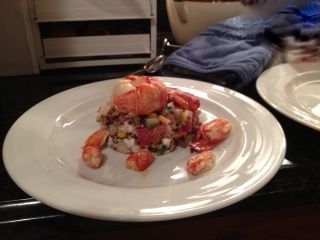
I took a small Tupperware – about four inches in diameter - filled it up half way with the hash, pressed it down, and then turned it over onto the plate.


Then I added the lobster tail on top of it, and the claw meat around it.  I have to say, this was the first time I thought about how the food would look on the plate.  I think I did ok, but not great.  But, at least I have started to consider how my food looks on the plate.


As for the taste, the hash was really good.  The potato was soft but not mushy, the same with the corn.  The red onion brought a little bit of crunch to offset the creamy texture that the goat cheese brought to the dish, and the goat cheese was actually not overpowering, although I think it was the primary flavor.  The dill cut the flavor back some.

As for the lobster, well, what does lobster taste like?  Does it really have a taste?  Some people say it tastes like a high quality shrimp but sweeter.  I don’t know if I agree with that.  I guess I would say it does have a certain sweetness to it, maybe something in between a shrimp and a scallop?  Hard to say.  The main thing I was worried about was overcooking the lobster, because if lobster is overcooked, just like calamari, it will have the texture of a rubber band.  Luckily, I timed everything just right.  The texture was nothing like a rubber band.  Perfectly tender…even the tail, which can be tough.  This was the first dish that I had so far, where I actually thought the butter/oil product I use brought a significant amount of flavor to the party.

On to the calories:  Total calories = 558.4.  Total Fat = 28 grams.  I would cut back on the amount of oil used to coat the potatoes by half next time. I think that would help a lot.  I used 3 ½ ounces of goat cheese…I might cut back on that a bit as well.

As for the future, once again work and family will be taking up some weekends, so it will be a bit before I can cook some more.  However, I am now moving on to braising.  Can’t wait to get started.  I hope you will all hang in with me.

Speaking of lobster, you can enjoy Maine Lobster or you can enjoy Rock Lobster!

Tuesday, October 16, 2012

Think Like a Chef Part - Salt Roasted Salmon


“What are you cooking Sunday?”  “Salt-roasted salmon.”  “…Alright…I’ll eat as much as I can…”

Needless to say, my wife is not a salmon fan.

Truth be told, she’s not a fish fan.  I’ve tried to make salmon a couple of different ways for her, but I always ended up eating half of it.  Granted, salmon has a stronger taste, but she has enjoyed all of the recipes from Tom Colicchio’s Think Like A Chef so far, including the pan roasted fish, so I figured, go for it!  Now, the question is, how to get her to eat it and maybe even enjoy it?

I mentioned before that I have someone who is following this series who is making really cool suggestions about side dishes and accompaniments.  That got me thinking about what I could serve with the salmon that would be new and interesting for me to cook, but be familiar enough for Cathy to enjoy.  I started looking through some other salmon recipes and I found an Emeril recipe where he makes a cauliflower puree.  Sounds good!  Hey…am I starting to think like a chef??

Okay, a word about fat.  One of my goals was to make these recipes low fat.  However, not all fats are created equal!  According to Fatsecret.com, a 4-ounce piece of salmon is 166 calories, 60 from fat.  But, according to Livestrong.com, the fat in salmon is omega-3 fatty acids, which can help protect against heart disease and other conditions.  It also has a ton of other nutrients and you can read that article here.

Now, the only added fat to the salmon was 1 tablespoon of extra- virgin olive oil and a bit more for drizzling.  Figure on ¼ being absorbed into each piece of fish.  No problem there.  As for the cauliflower puree…

The recipe for the cauliflower puree is ½ pound cauliflower, salt, pepper, extra virgin olive oil, and ½ cup of heavy cream…HEAVY CREAM?????

According to Fatsecret.com, ½ cup of heavy cream = 411 calories, of which 397 is fat, and we are not talking healthy fats!  So, if I wanted to make this, I needed to find a substitute. 

Unfortunately, I can’t locate the exact website I found, but one source said you could use fat free evaporated milk as a substitute for heavy cream.  This would provide a similar type of creaminess.  I used Carnation fat free evaporated milk.  One serving is 25 calories, so ½ cup would be 200 calories, zero from fat.  Half the calories and zero fat?  Sounds good to me!

Now, on to the actual cooking!

First, after trying unsuccessfully to cut off my thumb using a pairing knife to cut up the cauliflower, I rinsed the cauliflower in cold water, and put it in a pot of salted water.  Then I brought the water up to a boil, and let it simmer for 30 minutes.

As it simmered, I began to heat up the extra virgin olive oil in my cast iron skillet over medium high heat, and also pre-heated the oven to 400 degrees.  Now, this brings up an interesting point, which Colicchio mentions right away.  Throughout the roasting chapter, he says he prefers to roast at a lower temperature, because it helps bring out the flavors of whatever he is roasting.  However, because the salt will insulate the fish, you have to roast it at a higher temperature.

Now, after the oil was heated, I put the salmon on skin side down and was supposed to cook it for two to three minutes.  Well, I WOULD have done that had my salmon had skin on it.  My salmon did not.  In any case, I figured if I let it go the full three minutes, it would still form some type of crust on the fish. 

After the three minutes, I took the pan off of the heat and covered the fish in kosher salt.  It took approximately 1½ cups of kosher salt to get the job done.  Once the salmon was covered, it went into the oven.  The recipe called for 6 minutes to cook the salmon to medium rare.  Colicchio says that the top of the salmon should look slightly rare.  I knew if it looked rare at all, Cathy would not eat it, so I chose to go one extra minute.

While the fish was in the oven, the cauliflower finished cooking.  I had to remove it from the heat, and drain.  Then into a blender went the cauliflower, the extra virgin olive oil, salt, pepper, and the evaporated milk.  I blended it until smooth, and tasted it.  It seemed it needed more seasoning, so I added a bit more salt and a lot of pepper.  Tasting it again, it was really quite good, although, unlike potatoes, it is not something I would eat by itself.

Now the fish was done cooking, so I took the fish out of the oven, and transferred it to my cutting board.  I started to take off the salt dome.  


I then brushed the salt off of the fish.  Now, time to plate.

First, I put the cauliflower puree on the plate.  


Next I put the salmon on top of the puree.  


Then, I drizzled a little bit of extra virgin olive oil over the salmon.  


Finally, it was time to taste.

The fish was cooked to a perfect medium.  It did indeed get a crust on the bottom of the salmon.  Although cooked to medium, the salmon was still quite firm but not tough, and not fishy tasting at all.  It did have a salty taste, no question about it, but it wasn‘t over powering.  The cauliflower puree was quite creamy.  I guess I would describe the taste as kind of a mild, nutty flavor. 

The real test?  Cathy ate the entire piece!  I wouldn’t say she loved it, but it was the first time I ever saw her eat an entire piece of salmon.

Finally, the calories:  We had a six ounce piece of salmon, which is about 249 calories, 90 from fat, but remember, the vast majority is good fat.  Between the olive oil absorbed in cooking, the drizzle on the fish and the cauliflower puree of which half was left over, I figure roughly ¾ of a tablespoon, all fat, but again, good fat, as it is monounsaturated.  Because half of the puree was left over, the calories from the fat free evaporated milk was 50 calories, zero from fat, and the cauliflower was ½ pound, approximately 4 cups raw (total guess) so per serving that is another 25 calories, only 1 from fat.  That makes the totals:

Calories = 414, Fat = 181 (remember, mostly all good fats).

So I think this dish was a complete success.  The only thing I would do different is make a side dish like asparagus next time to add a little bit of color to the plate…am I thinking like a chef again??